
West Memorial: Conserving a Heritage Landmark for Canada's Judicial System
Ottawa, Ontario
Project Lead: Public Services and Procurement Canada (PSPC)
Project Duration: 2018 – present
Services: Project Management, Security & Smart Technologies
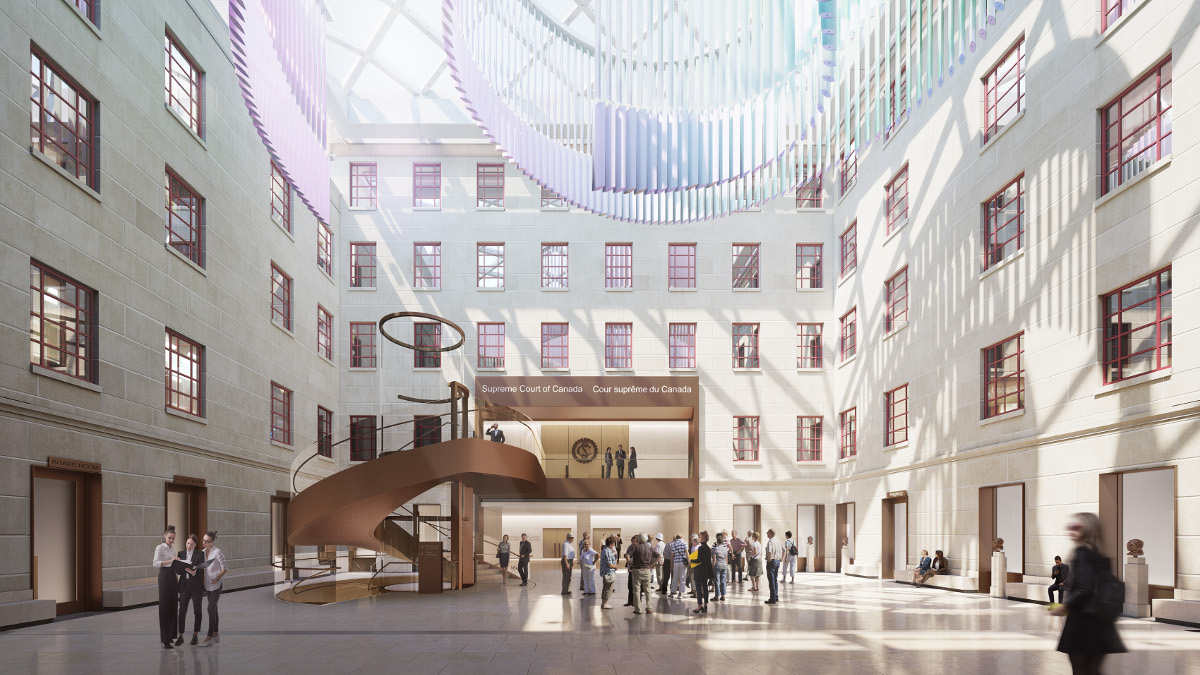
An interior rendering of the West Memorial Building lobby
The West Memorial Building is undergoing an extensive rehabilitation to conserve its heritage features and modernize the building.
This rehabilitation was undertaken to accommodate the Supreme Court of Canada during the renovation of 301 Wellington, also known as the Supreme Court of Canada Building.
Constructed between 1954 and 1958, the West Memorial Building (West Memorial) is located across from the Supreme Court and connected to the East Memorial Building via the Memorial Colonnade. It is classified as a federal heritage building because of its historical, architectural, and environmental significance.
Vacant since 2008, the building has undergone no major repairs or renovations since it was originally constructed to house various government departments, including the Department of Trade and Commerce, and honour Canadian soldiers who served during the Second World War.
Despite this, the building’s location, prominence, and size made it a suitable choice to temporarily accommodate the Supreme and Federal Courts. This is the first time the Supreme Court of Canada has relocated since they took occupancy of 301 Wellington in 1946.
Project Goals
7 storeys (approximately 20,000 m2) are being rehabilitated as part of the restoration of West Memorial.
Project objectives included:
- Rehabilitating exterior walls, windows, and interior finishes
- Removing contaminated soils and hazardous materials
- Reinforcing and upgrading the structure
- New shear walls, reinforcement of beams and columns, and slab topping
- New skylights and structural roof
- New civil site services
- Landscaping, including lighting, paving, and sidewalks
- Seismic upgrades
Due to the sensitive nature of the Supreme Court’s operations, the rehabilitation also required incorporating new preventative and detective security measures throughout.
Tiree’s Role
Tiree is supporting Public Services and Procurement Canada (PSPC) by delivering Project Management and Security & Smart Technology services focused on programmatic requirements, heritage preservation mandates, technology needs, and operational constraints.
Construction on West Memorial began in 2020, just as the COVID-19 pandemic began, requiring both office staff and on-site construction to adapt.
Working in close collaboration with the Supreme Court of Canada, Courts Administration Service, Department of Justice Canada, Royal Canadian Mounted Police (RCMP), Veterans Affairs Canada, City of Ottawa, Federal Heritage Buildings Review Office (FHBRO), and the National Capital Commission (NCC), Tiree supported PSPC by providing subject matter expertise and representing the client’s interests during complex coordination and design meetings.
With a focus on sustainability, West Memorial’s design was customized to meet Green Globes standards, with a focus on initial and lifecycle costs, material reuse and recycling, and the reduction of greenhouse gas emissions, in alignment with the Federal Sustainable Development Strategy. The project was awarded four Green Globes in July 2020.
Tiree also assisted PSPC with furniture, fixtures, and equipment procurement and coordination services, contributing to the building’s overall functionality and finish—a key consideration for the Supreme and Federal Courts’ operations.
Project Outcomes
As construction nears completion, with occupancy expected in Summer 2026, West Memorial is being outfitted with office space for Supreme Court judges, multiple courtrooms, public event space for exhibitions and tours, two functional courtyards enclosed with skylights, and a library that serves as a document archive for the Supreme Court.
Following this, the Supreme Court of Canada building (301 Wellington) will be renovated.
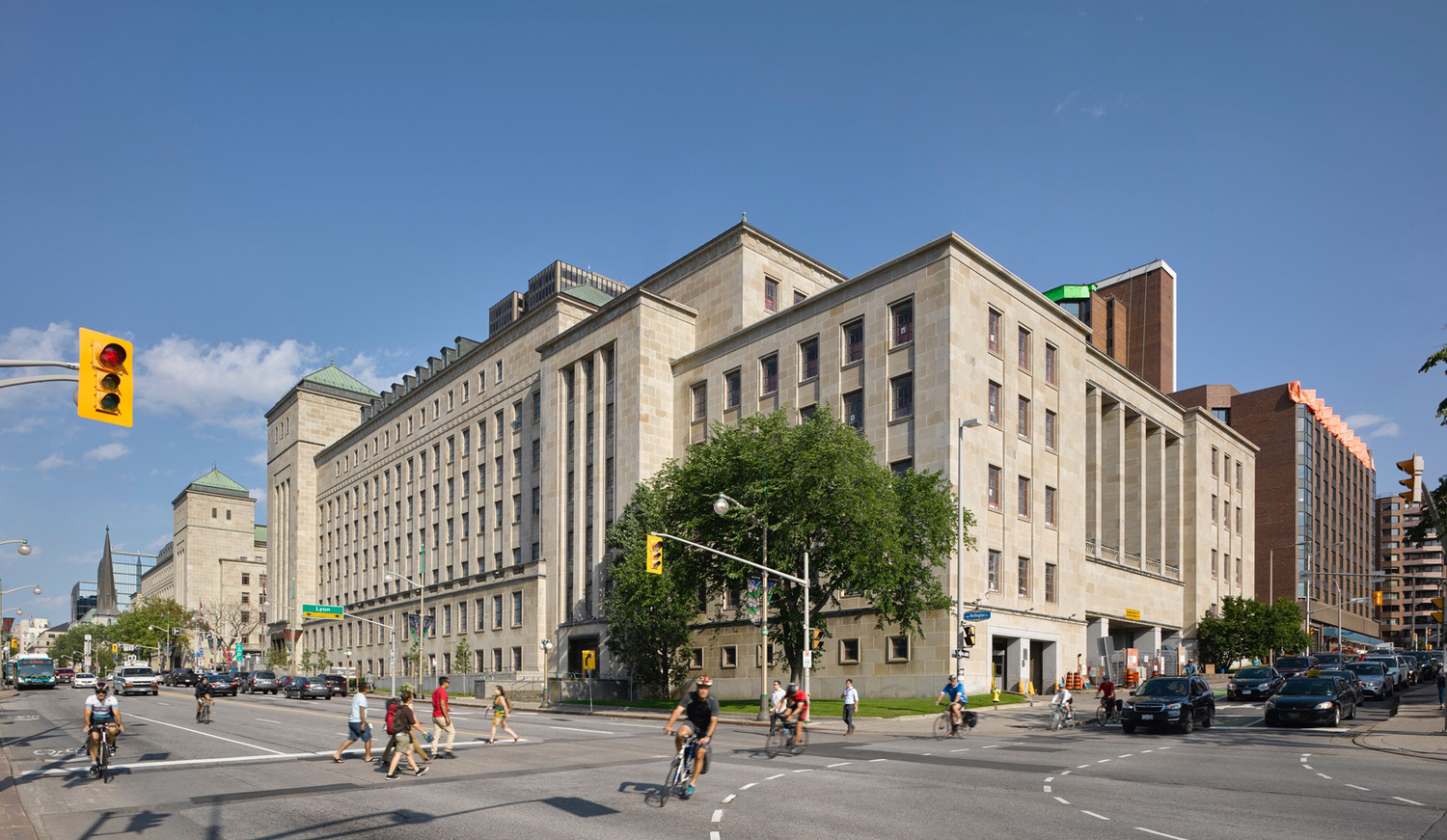
Exterior of the West Memorial Building